

For the soldiers huddled in trenches along the thousand-kilometer front line in Ukraine, the threat no longer comes just from artillery shells or tanks. It comes as a low buzz in the sky—a small, cheap reconnaissance drone that can correct artillery fire or a “loitering munition” waiting to strike. In this new age of warfare, the ability to “zap” these airborne threats out of the sky has become as crucial as ammunition and food. And in this electronic battle, Australian defence companies are proving to be unlikely but vital gun slingers.
While Australia has pledged over $1.7 billion in military aid since the start of the conflict—including recent packages of $95 million for air defence radars and drones —it is the work of private firms on the ground that is providing a technological edge. Two Australian companies, in particular, are at the forefront of this effort: DroneShield and Codan.
The Sci-Fi Weapon in a Real War
Sydney-based DroneShield has become something of a phenomenon. Its share price has skyrocketed as Western governments scramble to equip their forces with counter-drone technology. The company’s CEO, Oleg Vornik, describes the modern battlefield to the AFP as a place where “you have to now assume the threat from the air is just as likely as the threat from the ground” .
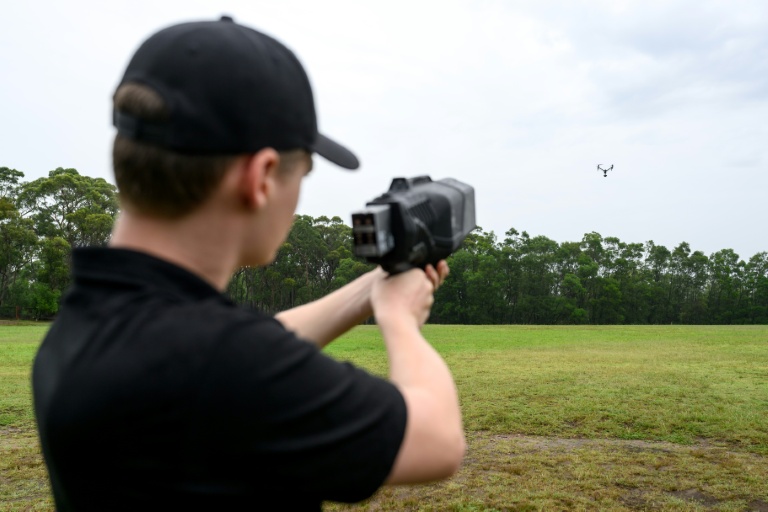
DroneShield’s solution looks like something out of a science fiction film: the DroneGun Tactical. Resembling a bulky, high-tech rifle, the device doesn’t fire bullets but rather “zaps” drones with directional concentrated radio wave energy. In the field, a technician can scan for enemy UAVs, aim the device, and pull the trigger. The signal disrupts the drone’s control, navigation, and video feed simultaneously. Vornik explains the effect simply: “The drone says: ‘Okay, I’m lost. I don’t know where I am, so I’m just going to crash or gonna land” .
It is a stark contrast to the brutal reality of the front lines, where, as Vornik notes, if you see or hear a drone, it is “probably too late… you’re very likely to die” .
Battlefield Innovation at Silicon Speed
While DroneShield provides the “hardware” for the counter-drone fight, another Australian firm, Codan, is providing the invisible shield—the communications backbone. The Ukraine conflict has evolved into a brutal battle for the radio frequency (RF) spectrum. Jamming is constant, and GPS signals are unreliable.
According to a presentation at the Military Communications and Information Systems (MiLCIS) conference in Canberra, Codan has had personnel in Ukraine since the invasion began, working directly with local manufacturers to adapt to the rapidly changing electronic warfare environment .
Dr. Jack Sudarev, Codan’s Chief Technical Officer, notes that the timeline for innovation in this war is not months or years, but “weeks (or) days” . When Russian forces jam a specific frequency, Ukrainian systems need to adapt instantly. Because Codan’s radios are software-defined, they can release new firmware every three months, allowing Ukrainian drone operators to switch channels and maintain control of their UAVs even in a contested environment. As Matt Jones from Codan DTC puts it, the lessons learned from being “tested” in Ukraine flow back into every firmware update, benefiting not just Ukraine but future users of the technology .
More Than Just Tech Support
This collaboration is more than a simple vendor-client relationship. It has become a two-way street of innovation. Ukraine’s Ambassador to Australia, Vasyl Myroshnychenko, has actively urged Australian companies to use the “millions and millions of hours of battlefield information” Ukraine has gathered . He argues that Ukraine is not a liability but an “asset” that can help allies like Australia prepare for future conflicts by sharing data on what works—and what doesn’t—against Russian electronic warfare .
This data is already being used back home. Australian companies like Thales are integrating lessons from Ukraine into new equipment. For instance, Thales Australia has been testing a version of the Bushmaster armored vehicle equipped with an electronic jamming system designed to automatically detect and adapt to drone threats, a direct response to the vulnerability of armored vehicles exposed in Ukraine .
The ‘Year of the Drone’ and Its Challenges
The rise of these companies has not been without controversy. DroneShield’s rapid ascent led to questions about whether it was a “meme stock,” driven by hype. Vornik sold a significant stake last year, causing a temporary dip in shares, a move he attributes to paying taxes and securing his financial future .
Yet, the strategic need for their products remains undeniable. Drones have become an integral part of modern warfare because they are cheap, ubiquitous, and effective. As Steven Feldstein from the Carnegie Endowment for International Peace notes, “They do things that otherwise are much more expensive and much harder to replicate using traditional munitions” .
However, the battle is never static. While companies like DroneShield focus on RF jamming, other Australian firms like Electro Optic Systems (EOS) warn that many modern drones are becoming hardened against electronic interference, relying on pre-programmed flight paths. EOS is investing in “hard-kill” solutions like lasers and precision kinetic weapons to shoot drones down when jamming fails .
As Australian Financial firm Bell Potter declares 2026 the “Year of the Drone,” the work of Australian defence firms in Ukraine serves as a critical proving ground . They are not just helping Ukraine defend its skies today; they are ensuring that the ADF is prepared for the conflicts of tomorrow, one zap at a time.
 Jerry
Jerry