

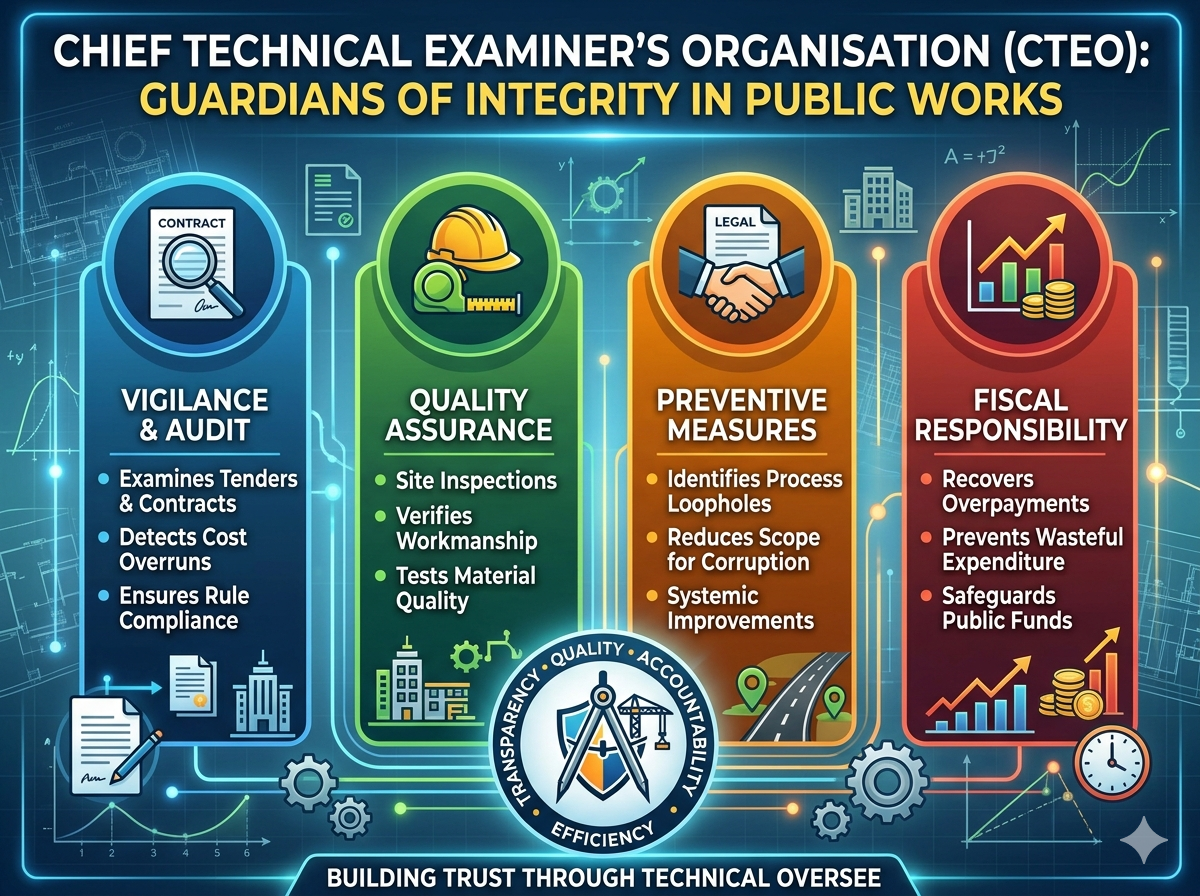
The Chief Technical Examiner (CTE) is a high-ranking technical and administrative official tasked with the oversight, auditing, and inspection of major engineering projects and procurement contracts. Serving as the technical backbone of vigilance organizations, the CTE ensures that massive public investments in infrastructure—ranging from highways and dams to smart-city developments—are executed with transparency, quality, and fiscal responsibility.
This article provides an exhaustive exploration of the role, the structure of the Chief Technical Examiner’s Organisation (CTEO), and the rigorous methodologies used to safeguard public funds from corruption and inefficiency.
1. Historical Evolution and Statutory Framework
The concept of a dedicated technical examiner emerged from the necessity to bridge the gap between financial auditing and engineering reality.
- Origins (1957): The Chief Technical Examiner’s Cell was initially created within the Indian Ministry of Works, Housing, and Supply in May 1957 to provide specialized oversight for construction works.
- The Santhanam Committee (1964): Following the recommendations of the Committee on Prevention of Corruption, the CTEO was transferred to the newly formed Central Vigilance Commission (CVC) in November 1964.
- Statutory Status: With the enactment of the Central Vigilance Commission Act, 2003, the CTEO became a permanent technical wing with enhanced legal authority to examine any government-funded project.
2. Organizational Structure of the CTEO
The CTEO is designed to be a lean but powerful multi-disciplinary team. In the CVC’s organizational structure, it typically comprises:
| Role | Rank/Equivalent | Primary Focus |
|---|---|---|
| Chief Technical Examiner (CTE) | Chief Engineer | Strategic leadership, high-level policy, and final reporting. |
| Technical Examiner (TE) | Executive Engineer | On-site intensive examinations and detailed technical analysis. |
| Assistant Technical Examiner (ATE) | Assistant Engineer | Field data collection, measurements, and sample verification. |
| Junior Technical Examiner (JTE) | Junior Engineer | Supporting inspections and record-keeping. |
There are usually two CTEs at the apex: one focusing on Civil and Horticulture works, and the other on Electrical, Mechanical, and IT Procurement contracts.
3. Core Objectives of the Chief Technical Examiner
The CTE does not just find faults; it acts as a proactive reformer. Its primary objectives include:
- Preventive Vigilance: Identifying loopholes in the tendering and execution process before they can be exploited for fraud.
- Financial Recovery: Detecting overpayments, irregular advances, or billing for substandard work to recover lost revenue for the government.
- Quality Assurance: Ensuring that the physical infrastructure built with public money meets international safety and durability standards.
- Systemic Improvement: Suggesting changes to outdated engineering manuals and procurement rules to prevent recurring irregularities.
4. The Lifecycle of an Intensive Examination
The CTE’s work is characterized by “Intensive Examinations”—a deep-dive audit that covers the entire lifecycle of a contract.
A. Pre-Award Stage (Tendering)
The CTE examines whether the project was necessary and if the tendering process was fair. Key checks include:
- Need Analysis: Was the project justified, or was it a “wasteful expenditure”?
- Tender Transparency: Were the tender notices widely publicized, or was competition restricted to favor a specific contractor?
- Estimate Accuracy: Were cost estimates realistic or artificially inflated?
B. Award Stage (Contracting)
At this stage, the CTE looks for administrative red flags:
- Unfair Negotiations: Checking if post-tender negotiations were used to alter the scope or price unfairly.
- Performance Guarantees: Ensuring that Bank Guarantees and security deposits are valid and sufficient.
C. Execution Stage (On-Site Inspection)
This is the most critical phase where “boots on the ground” matter. The examiners conduct:
- Measurement Verification: Physically re-measuring work at the site to ensure the contractor isn’t overcharging for quantities (e.g., concrete volume or road length).
- Material Testing: Collecting samples of cement, steel, or bitumen for independent laboratory testing.
- Workmanship Audit: Checking for structural defects, poor finishing, or deviations from the approved technical specifications.
D. Post-Contract Stage (Final Settlement)
- Payment Verification: Reviewing final bills to ensure all deductions and liquidated damages for delays were applied correctly.
- Defect Liability: Confirming that the contractor remains accountable for any failures during the maintenance period.
5. Typical Irregularities and Common Findings
Decades of CTE reports highlight recurring issues in public works:
- Ad-hoc Decision Making: Lack of a proper “Works Manual” leading to arbitrary changes during construction.
- Substandard Materials: Using inferior grade materials while billing for high-quality ones.
- Unlinked Advances: Paying large sums of money to contractors without equivalent progress on the ground.
- Penalty Avoidance: Failing to levy fines (Liquidated Damages) on contractors who miss project deadlines.
6. Impact and Value Generation
The CTEO is one of the few government wings that often generates more “revenue” than it costs to run.
- Monetary Savings: In some years, recoveries from overpayments and irregular billing have been double the entire operating budget of the CVC. For instance, the Airports Authority of India (AAI) reported recoveries of ₹2.20 crores in a single year due to CTE-type examinations.
- Institutional Memory: By documenting lapses, the CTE provides a “lessons learned” database that helps government engineers avoid the same mistakes in future projects.
7. The Future of Technical Auditing
As construction moves toward “Smart Infrastructure,” the role of the Chief Technical Examiner is evolving:
- Digital Audits: Use of Building Information Modeling (BIM) and drone surveillance to verify site progress remotely.
- IT Procurement: With massive spending on software and cybersecurity, the CTE now examines IT contracts with the same rigor as civil engineering.
- AI Integration: Utilizing data analytics to predict which projects are at the highest risk of corruption based on historical patterns.
Conclusion
The Chief Technical Examiner stands as a vital guardian of the public exchequer. By combining engineering expertise with the investigative rigor of a vigilance officer, the CTE ensures that the bridges, roads, and buildings we rely on are not just completed, but are built with the quality and honesty that the public deserves.
Would you like to review specific CTE guidelines for civil works or see a sample check-list used during an intensive examination?